
On this page
Use a transfer bonus when you already have a specific award in mind, you've confirmed the seat or room is available, and the bonus lowers the points you'd spend on it. Ignore it when you'd be transferring "just in case". Points that sit in an airline or hotel program can't come back, and that program can change its prices before you use them.
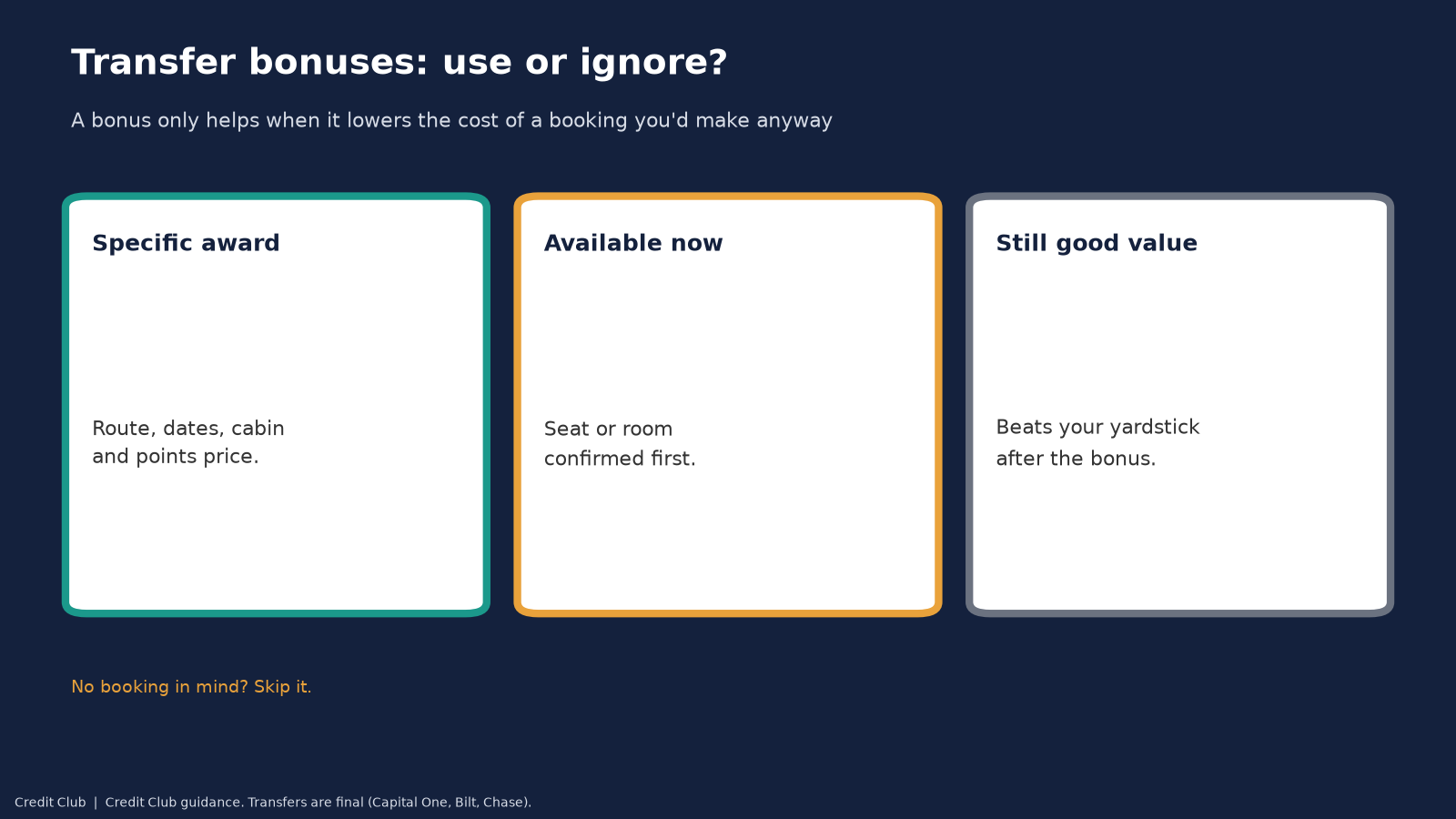
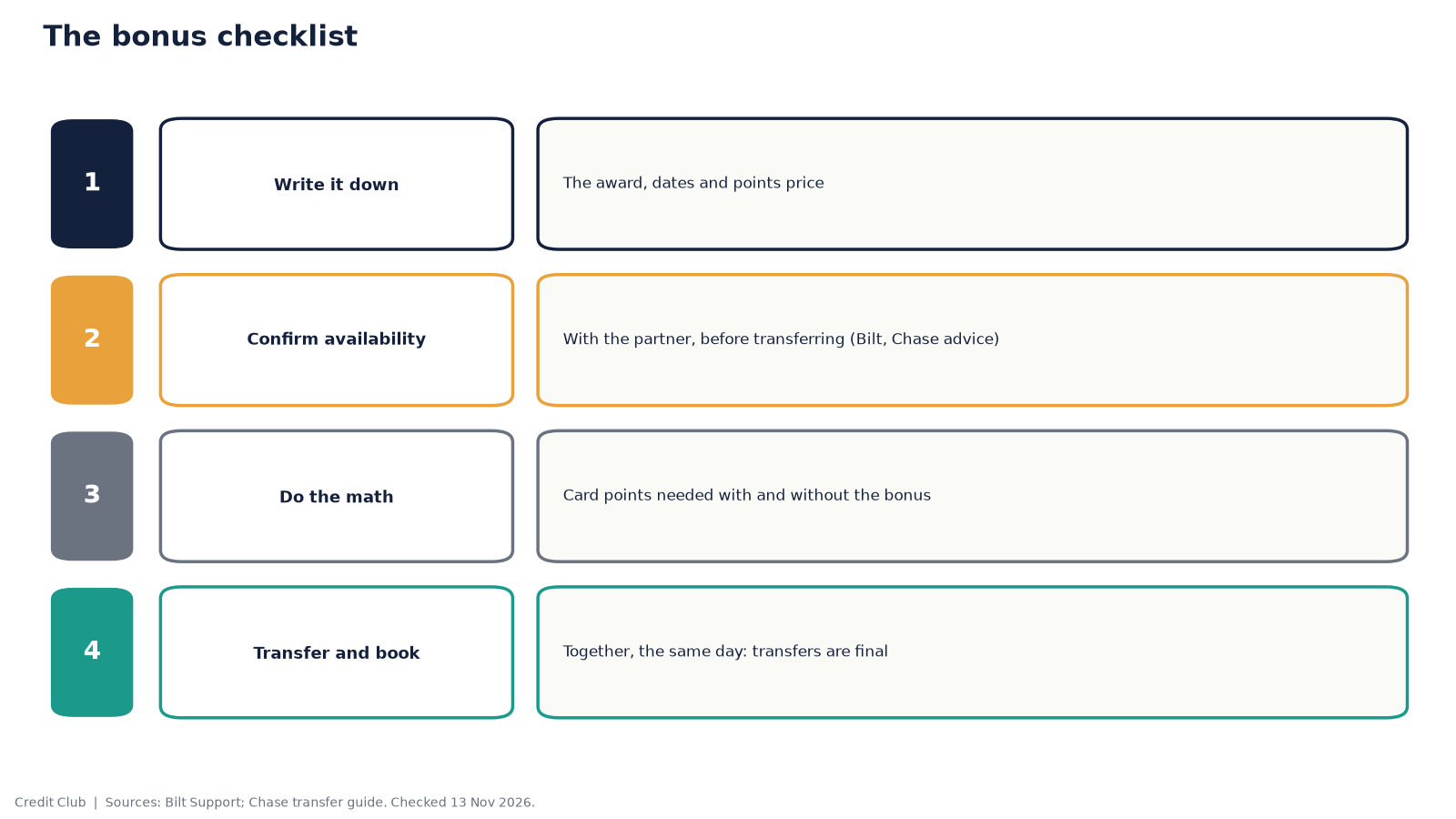
What we'd do first: when you see a bonus, write down the award you'd book with it, the points price, and whether it's available today. If you can't fill in all three, skip the bonus.
What a transfer bonus is
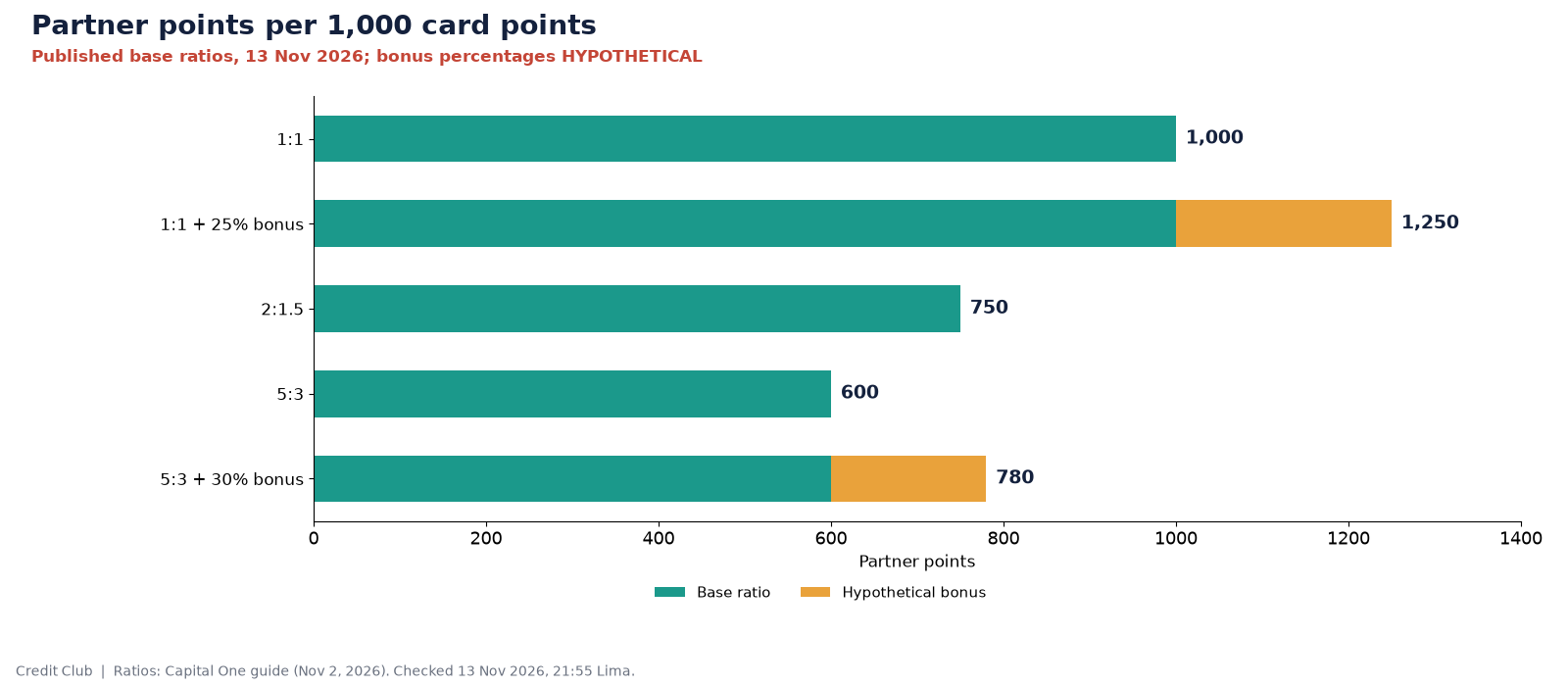
Card programs move points into airline and hotel programs at a set ratio, often 1:1. From time to time, they offer extra partner points for a limited period. Bilt, for example, says on its transfer page: "At times, we may offer promotions of varying transfer rates" (Bilt Rewards Support: Bilt's Transfer Partners, updated Oct 20, 2026, checked 13 Nov 2026, 21:55 Lima). A 25% bonus on a 1:1 partner means 1,000 card points become 1,250 partner points.
Bonuses are usually tied to one partner, run for a few weeks, and come with their own terms. Read them in your card account before you transfer: what counts is the offer as shown there, not a headline.
The effective ratio
Start by converting the bonus into an effective ratio:
Partner points per 1,000 card points = 1,000 × base ratio × (1 + bonus)
Base ratios aren't all 1:1. Capital One lists JetBlue at 5:3, meaning "1,000 Capital One miles convert to 600 miles or points", and Emirates, EVA, Japan Airlines and Copa at 2:1.5, or 750 per 1,000 (Capital One: miles transfer partners, dated Nov 2, 2026, checked 13 Nov 2026, 21:55 Lima). American Express lists Hilton Honors at 1,000 to 2,000 (American Express: transfer points, checked 13 Nov 2026, 21:32 Lima). Chase lists World of Hyatt at 4:3 for current Sapphire Preferred transfers (Chase Sapphire Preferred benefits, checked 13 Nov 2026, 21:52 Lima).
So a 30% bonus to a 5:3 partner takes you from 600 to 780 partner points per 1,000. That's better than the base rate, but still below a plain 1:1 transfer without any bonus.
What a bonus saves on a real booking
The useful number isn't the percentage; it's the card points you save on an award you'd book anyway.
Card points needed = award price ÷ effective ratio
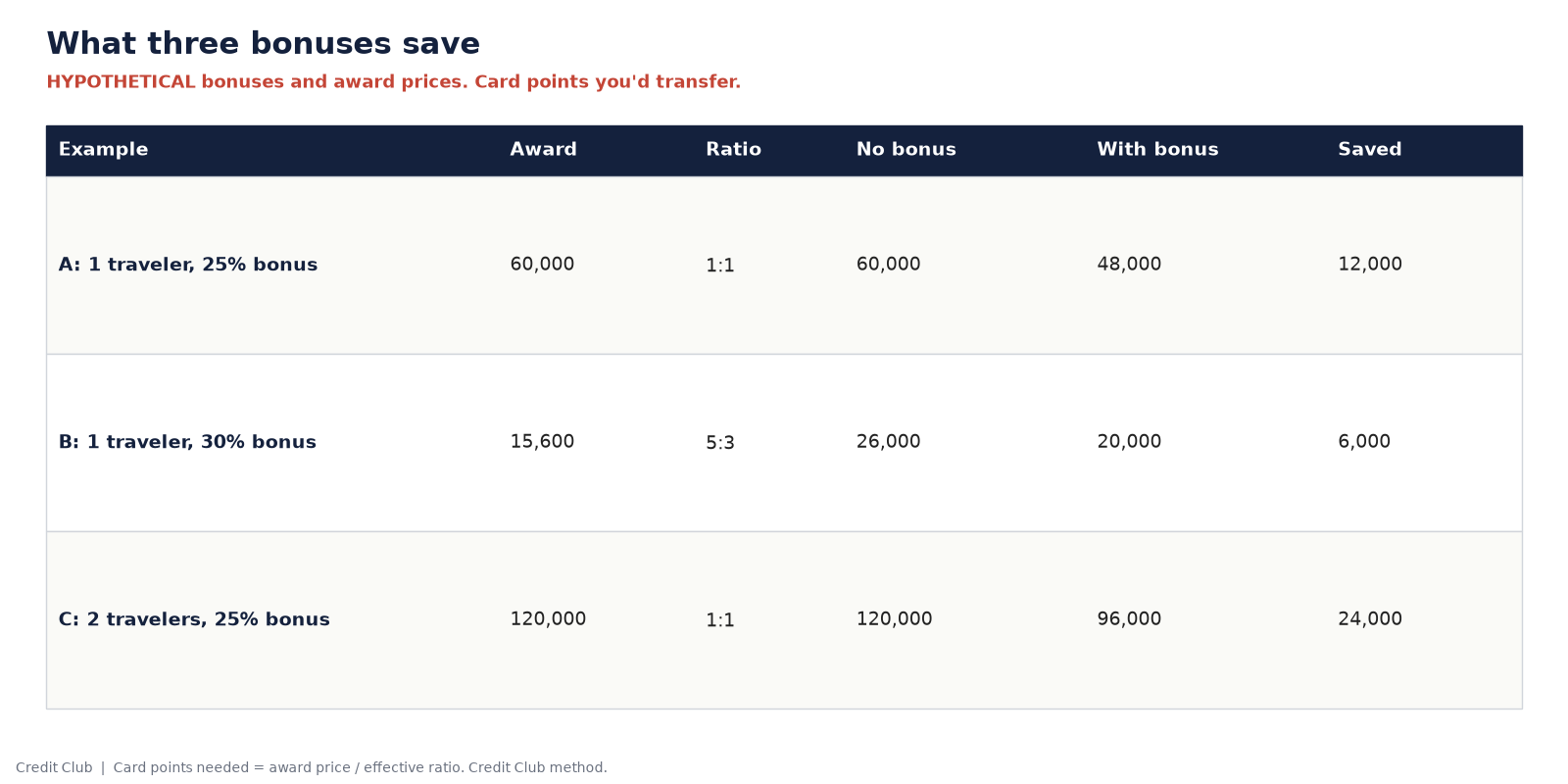
Example A: 1:1 partner, 25% bonus (hypothetical). You want an award that costs 60,000 miles, one traveler, one way. Without a bonus you'd transfer 60,000 points. With a 25% bonus you'd transfer 48,000 (60,000 ÷ 1.25). You save 12,000 points. At our assumed 1 cent per point, that's about $120 of value, an estimate rather than a cash saving.
Example B: 5:3 partner, 30% bonus (hypothetical). You need 15,600 JetBlue points for a flight. At 5:3, that's 26,000 Capital One miles (15,600 ÷ 0.6). With a 30% bonus, the effective ratio is 0.78, so you'd need 20,000 (15,600 ÷ 0.78). You save 6,000 miles.
Example C: two travelers (hypothetical). Two seats on the Example A award cost 120,000 miles. A 25% bonus cuts the transfer to 96,000 points, saving 24,000. Bonuses scale with the booking, which is why they matter more for families and couples, provided you can find two seats.
| Example (hypothetical bonus and award) | Award price | Base ratio | Points without bonus | With bonus | Saved |
|---|---|---|---|---|---|
| A: 1 traveler, 25% bonus | 60,000 | 1:1 | 60,000 | 48,000 | 12,000 |
| B: 1 traveler, 30% bonus | 15,600 | 5:3 | 26,000 | 20,000 | 6,000 |
| C: 2 travelers, 25% bonus | 120,000 | 1:1 | 120,000 | 96,000 | 24,000 |
When to use one
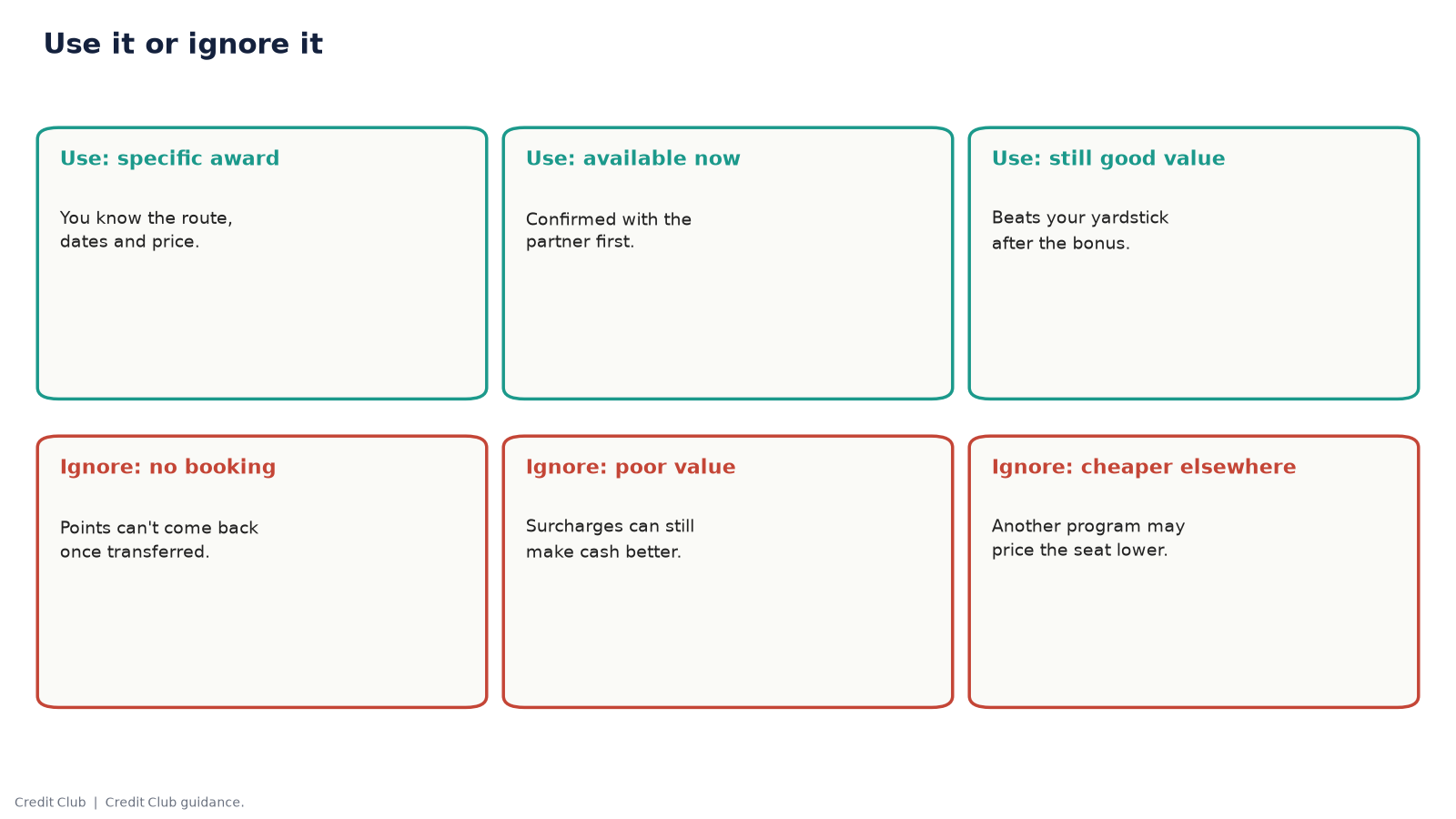
- You have a specific award. You know the route, dates, cabin and points price.
- The seat or room is available now. Bilt recommends "confirming the flight or hotel availability with the loyalty partner prior to transferring points", and Chase's transfer guide gives similar advice (Chase: How to transfer Ultimate Rewards points, checked 13 Nov 2026, 21:37 Lima).
- The award still beats your yardstick after the bonus. Run the cents-per-point check using the card points you'd actually transfer.
- The partner is one you'll use again. If a few points will be left over, they're more likely to be useful.
When to ignore one
- No booking in mind. Transferring to "stock up" turns flexible points into points that only work in one program. Capital One says "there's no way to transfer miles back"; Bilt says transfers "cannot be reversed".
- The award is poor value anyway. A bonus on an award with heavy surcharges can still lose to paying cash. See when cash beats points.
- A cheaper program exists. A 30% bonus to one partner may still cost more points than a no-bonus transfer to another partner that prices the same seat lower. Our award charts versus dynamic pricing guide explains why prices vary by program.
- The bonus expires before you can confirm. Don't rush a transfer to beat a deadline if you haven't found the seat.
Hotel transfer bonuses
The same math applies to hotel partners, but the stakes are different. Hotel programs often need large point balances for a single night, and some card ratios already favor them (Amex to Hilton is 1,000 to 2,000). A bonus on a hotel transfer is worth the most when you've already found the property and dates, and the award night price is fixed or known. Hyatt, for example, said in February 2026 that it keeps "fixed point thresholds rather than moving to dynamic pricing" for award nights (Hyatt newsroom, February 25, 2026, checked 13 Nov 2026, 21:48 Lima), which makes the points you'll need easier to predict before you transfer.
Compare the result with the cash rate, including taxes and fees, as you would for a flight. If a hotel bonus only makes a poor-value night slightly less poor, it's still a pass.
How to keep track without chasing bonuses
You don't need to watch every offer. A simpler routine:
- Keep a short list of the two or three awards you're actually planning this year.
- When a bonus appears for a partner that prices one of those awards well, check availability that day.
- If the seat or room is there and the numbers work, transfer and book together.
- If not, let the bonus pass. Another offer, or a standard transfer when you're ready, will do.
This keeps your points flexible until the moment they have a job.
Trade-offs
- Speculative transfers carry two risks. The partner program can raise award prices, and your plans can change. Example: moving 50,000 points with a 30% bonus gives 65,000 partner miles (hypothetical), but if the award you wanted then costs more, or you never travel, the bonus didn't help.
- Timing. Transfers aren't always instant. Chase says most process "by the next business day, but may take up to 7 business days"; Bilt says "up to 48 hours", or 72 hours for Southwest. A seat can disappear while you wait.
- Leftovers. Partner points often come in increments. You may end up with an odd balance in a program you rarely use.
Fallback
If there's no bonus, or it doesn't fit, transfer at the normal ratio when you're ready to book, or use a fixed-value redemption. Bonuses come and go; a good award at the standard ratio is still a good award.
Transfer bonuses: FAQs
How often do bonuses happen?
It varies by issuer and partner. Card programs don't publish a schedule.
Is a bigger percentage always better?
No. A 30% bonus to a 5:3 partner gives fewer partner points than a 1:1 transfer with no bonus. Compare effective ratios.
Can I get the bonus later if I transfer early?
Generally no. Bonuses apply to transfers made within the offer period under its terms.
For how each US currency reaches each partner, see transferable points explained.