
On this page
If an airline significantly changes your flight and you don't accept the change or the alternative it offers, US rules say you're owed a refund, and for an award ticket that includes the miles, in their original form, plus the taxes and fees. Before taking a refund, check whether the airline will move you to a better flight; many will, but it's their policy, not a rule. Decide quickly, because award seats on other flights go fast.
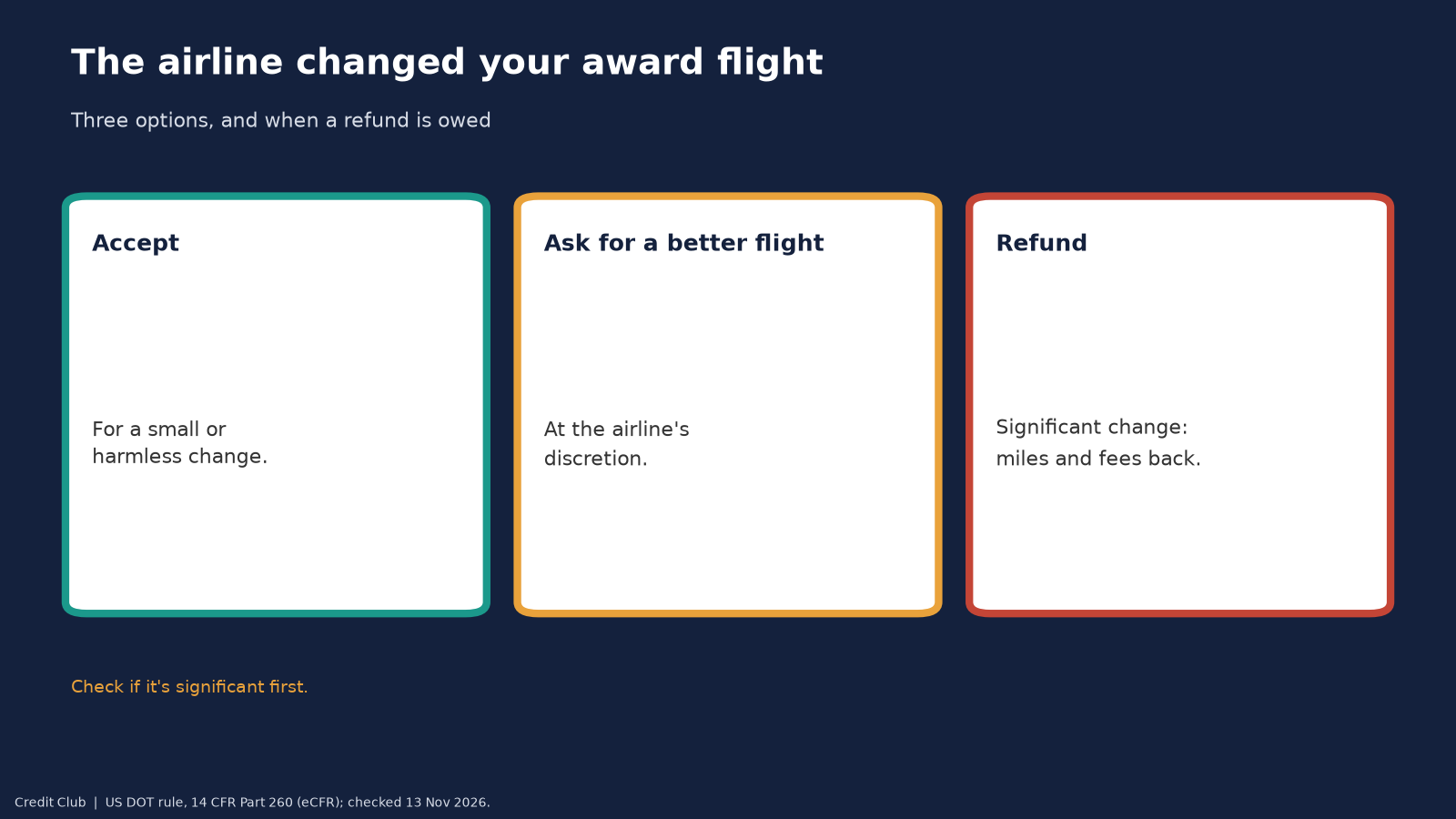
What we'd do first: compare the new times with your old ones and check whether the change is "significant" under the US definition below.
What US rules count as a significant change
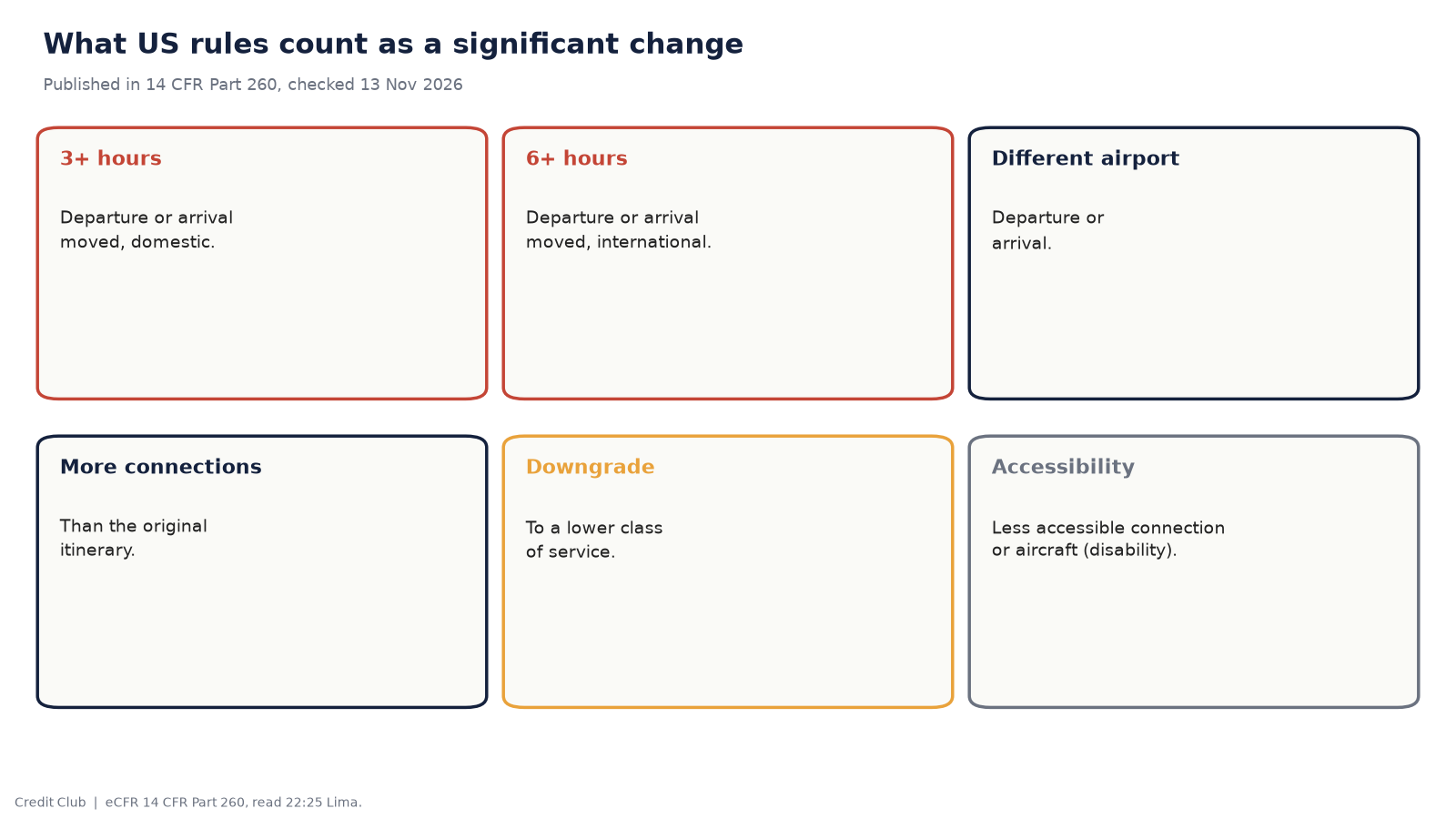
The Department of Transportation's refund rule (14 CFR Part 260) defines a significant change. It includes:
- departure or arrival moved by 3 hours or more on a domestic itinerary, or 6 hours or more on an international one;
- a different departure or arrival airport;
- more connections than the original itinerary;
- a downgrade to a lower class of service;
- connections at different airports, or on different planes that are less accessible, for passengers with a disability.
Source: eCFR: 14 CFR Part 260, refunds for airline fare and ancillary service fees, checked 13 Nov 2026, 22:25 Lima. The rule applies to US airlines and to foreign airlines for flights to, from or within the US.
What you're owed
If the change is significant and you reject it, and reject any alternative offered, the rule says the airline must give a full refund of the fare, "including any taxes and ancillary fees". It also says refunds go back in the "original form of payment", which it explains can include "airline miles", and that no processing fee can be charged. Refunds paid by credit card are due within 7 business days; others within 20 calendar days. (Paraphrased from 14 CFR §§260.6 and 260.10; read the full text for the conditions.)
For an award ticket, that means your miles back in your account and the cash taxes and fees back on your card. It doesn't mean the points go back to Amex or Chase: a transfer from your card program to the airline is final, so the miles stay in the airline account.
If the airline offers a voucher or credit instead, the rule says it's an alternative you can choose, not a requirement, and such vouchers must stay valid for at least five years.
Your three options
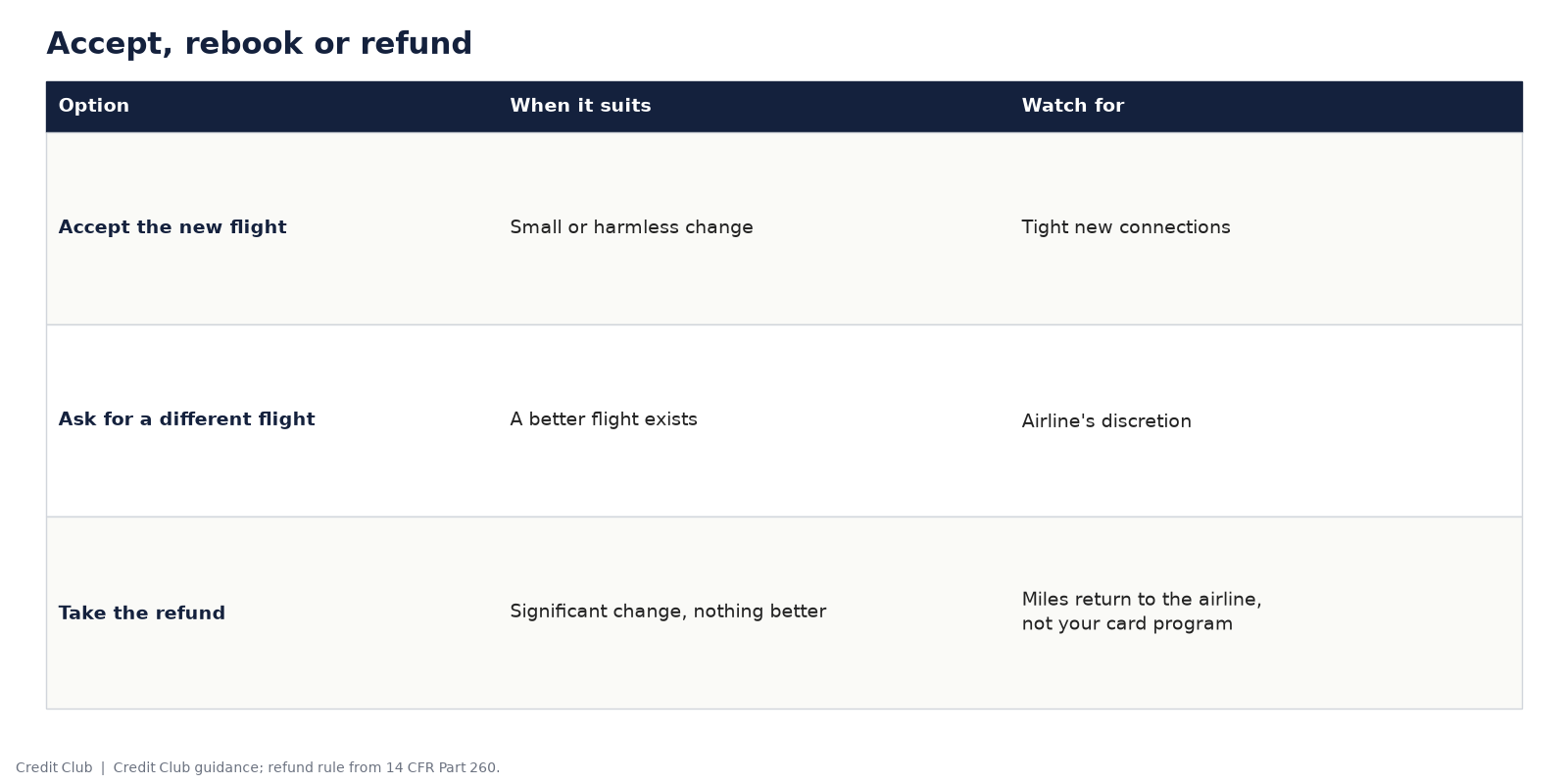
| Option | When it suits | Watch for |
|---|---|---|
| Accept the new flight | The change is small or harmless | Tight new connections |
| Ask for a different flight | A better flight exists, even with no award space | It's at the airline's discretion |
| Take the refund | Significant change and nothing better | Miles go back to the airline account, not your card program |
Asking for a better flight
Airlines often rebook schedule-change passengers onto other flights, sometimes beyond normal award space, but whether they do, and how far they'll go, is set by each airline's own policy. We couldn't load the current schedule-change pages for the main US airlines, so we don't state their specific rules. When you call:
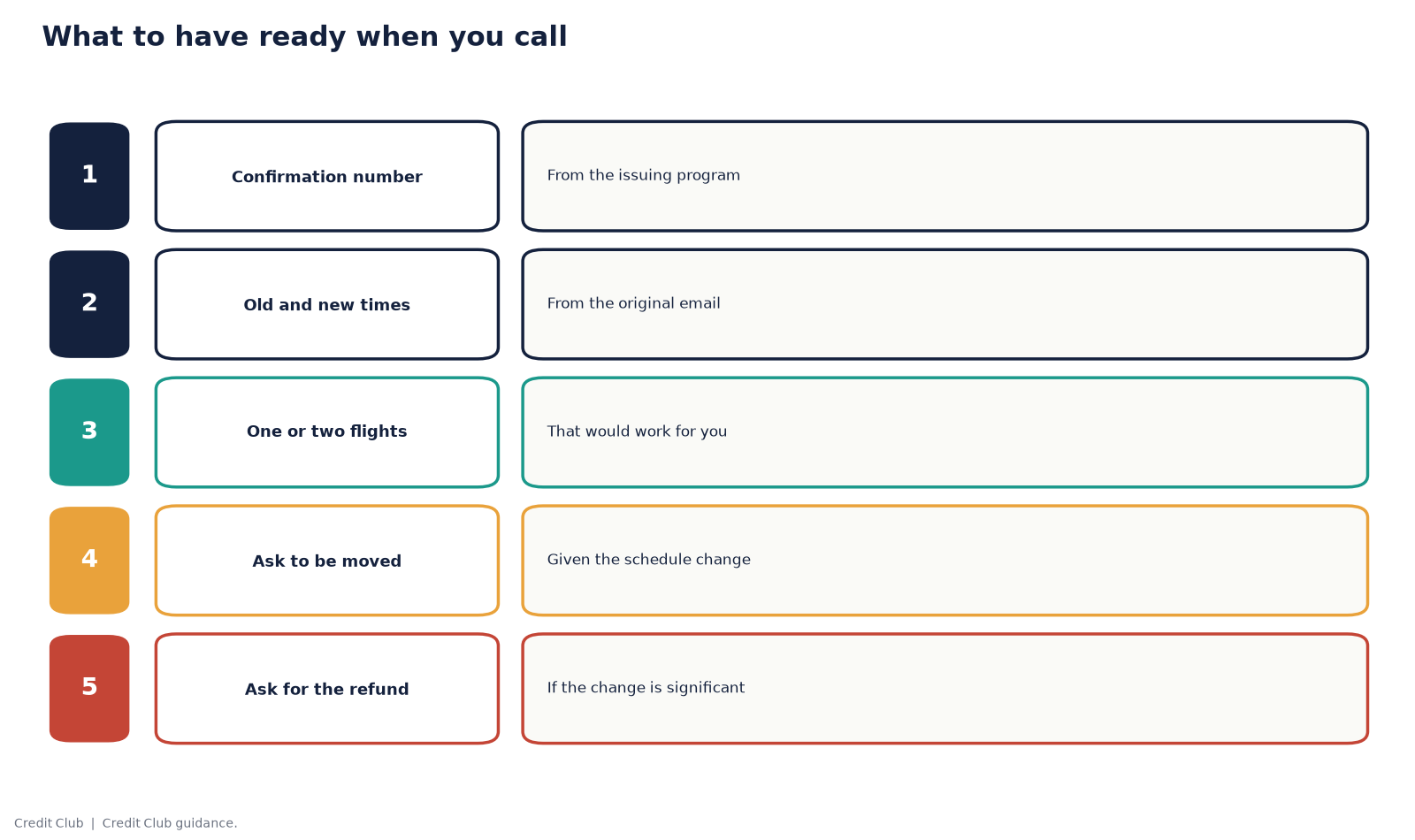
- have your confirmation number and the original and new times;
- name one or two specific flights that work for you, ideally on the same airline or a partner on the ticket;
- ask whether they can protect you on that flight given the schedule change;
- if the answer is no, ask about the refund under the significant-change rule.
A worked example (hypothetical)
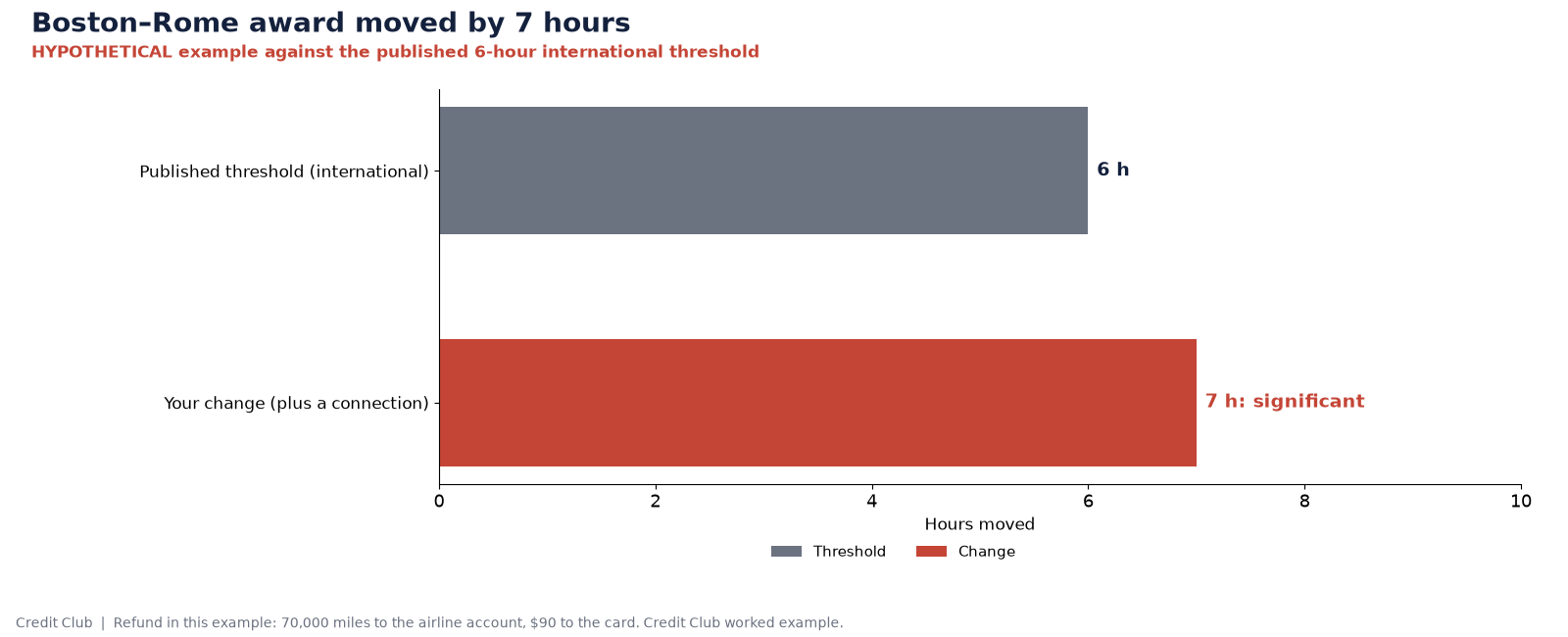
You booked a Boston–Rome award in business class: 70,000 miles + \$90 in taxes and fees. The airline moves the outbound by 7 hours and adds a connection. That's more than the 6-hour international threshold, and there's an extra connection, so it meets the US definition. You ask for an earlier nonstop on the same airline; the agent can't place you there. You reject the change and ask for a refund: under the rule, the 70,000 miles go back to your airline account and the \$90 back to your card. Illustration only; not a case we handled, and the outcome depends on the airline applying the rule to your booking.
Partner awards
If you booked one airline's flight with another airline's miles, the program that issued the ticket handles the change, though the operating airline caused it. Aeroplan's policy, for example, says changes "are subject to availability and may require use of additional Points" for voluntary changes; involuntary changes follow the program's own processes and the US rule where it applies (Aeroplan Flight Reward Policy, checked 22:27 Lima). Call the program that issued the ticket, not the operating airline.
How to check your own change
- Find the original itinerary. Use the first confirmation email, not the updated one.
- Compare departure and arrival times. Measure the bigger of the two differences against the threshold: 3 hours domestic, 6 international.
- Count the connections. One more than before counts, even if the total time is similar.
- Check the airports and the cabin. A different airport, or business moved to economy on any segment, counts.
- Write it down. Note which part of the definition the change meets; it makes the call shorter.
When to act
Act soon after the change notice arrives. The refund right doesn't vanish overnight, but the alternatives do: other award seats and good flights get booked by other passengers who were moved too. If you're happy with the new flight, accepting early can secure your seat assignment as well.
Mistakes to avoid
- Accepting without reading. Some apps accept changes with one tap. If you accept, you may lose the refund right for that change.
- Cancelling it yourself. A voluntary cancellation can trigger the program's own fees; ask for the schedule-change refund instead.
- Calling the wrong airline. On a partner award, the issuing program owns the ticket.
- Assuming points go back to your card. They go back to the airline account.
Trade-offs
- Accepting keeps your trip intact but may cost time.
- Rebooking can produce a better flight but depends on goodwill and availability.
- Refunding returns the miles and fees but leaves you to find a new award, which may cost more.
Fallback
If the airline won't help, take the refund, then search again with our guide to finding award availability. If you need to fly anyway, compare the new award with a cash fare using our guide to points or cash. If you think you're owed a refund you haven't received, the DOT accepts complaints about airline refunds.
Schedule changes: FAQs
Does a 2-hour change count?
Not under the US significant-change thresholds (3 hours domestic, 6 international). The airline may still help.
Will I get my Amex or Chase points back?
No. The miles return to the airline account; transfers from card programs are final.
Do I have to accept a voucher?
The rule treats it as an option. You can ask for the refund instead if the change is significant.
How fast should the refund arrive?
The rule says 7 business days for credit card payments and 20 calendar days for other payments.
What if the airline cancels the flight entirely?
The same rule covers cancellations: if you don't accept the alternative, you're owed a refund, including miles in their original form.
Does this apply to flights outside the US?
The rule covers flights to, from or within the US. Other countries have their own rules.