
On this page
- The flights: what Aeroplan publishes
- The three budgets
- The full cost of each budget
- Where the cash goes
- Choosing your budget
- A first step for each budget
- Worked example: the Middle budget, step by step (hypothetical)
- When to skip points for part of the trip
- Mistakes to avoid
- Trade-offs
- Fallback
- Europe on points: FAQs
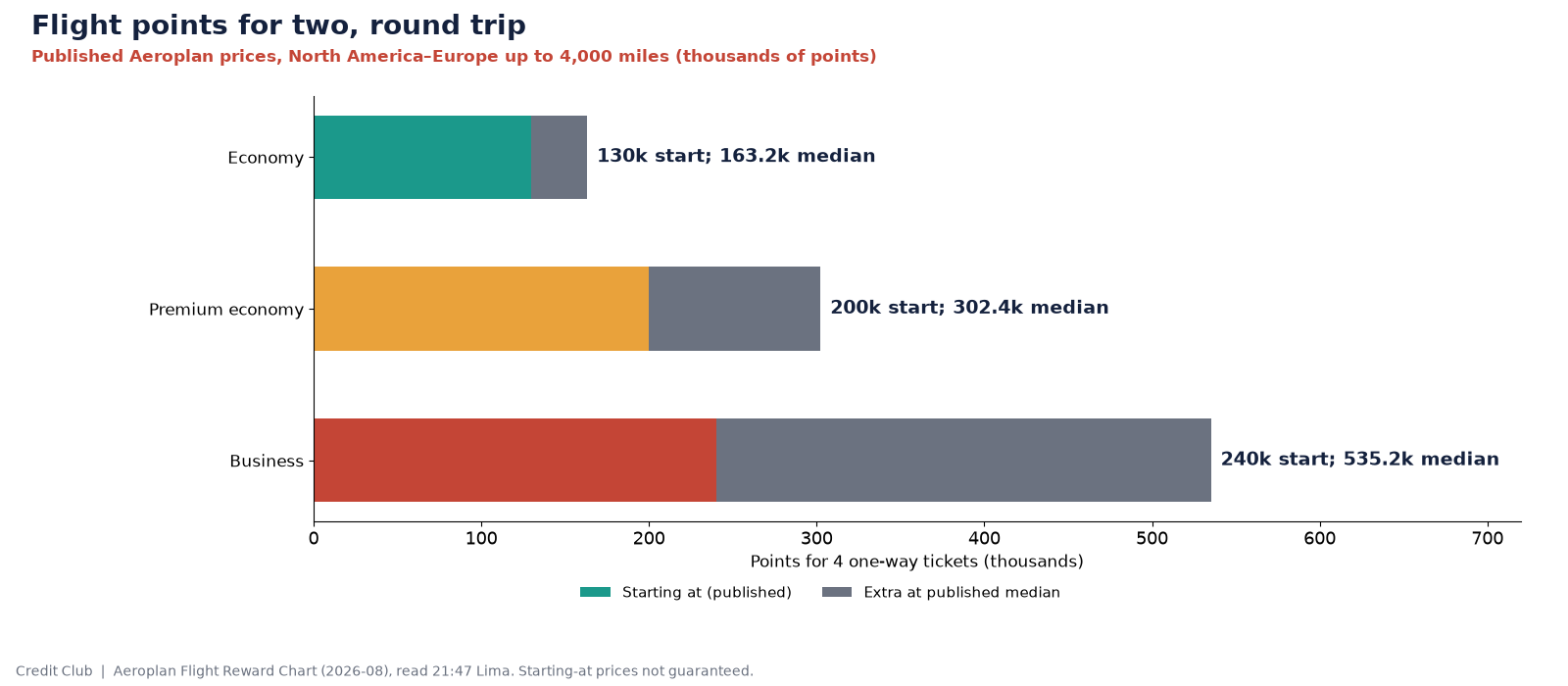
For two people flying round trip from the US East Coast to Western Europe, Aeroplan's published chart starts at 130,000 points in economy, 200,000 in premium economy and 240,000 in business for the flights alone, plus taxes and fees. Add seven hotel nights on points or cash and the trip ranges from roughly 130,000 points plus about \$1,500 cash to about 450,000 points plus a few hundred dollars, depending on the budget (hotel and cash figures hypothetical). "Starting at" prices are the floor, not a promise.
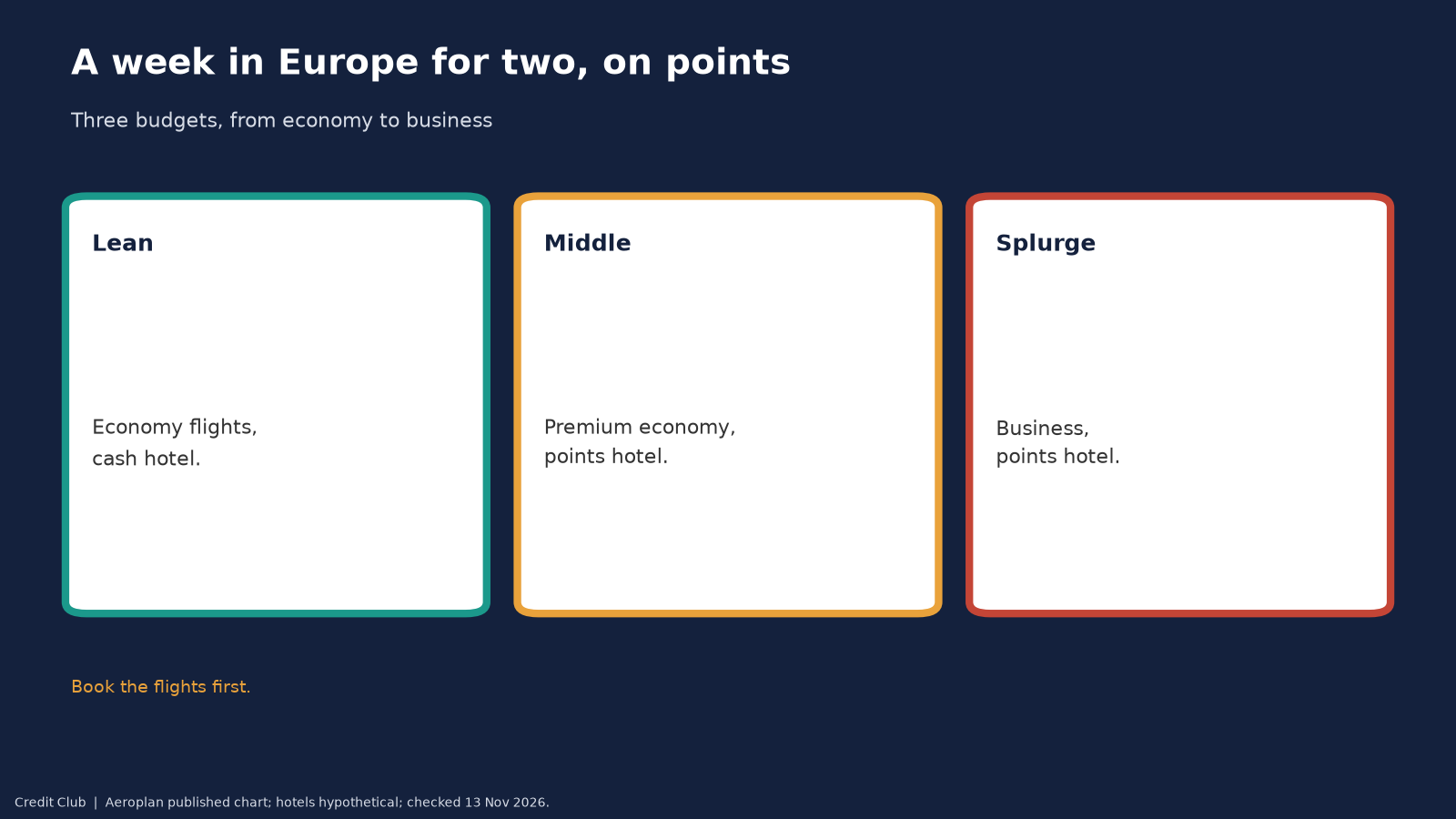
What we'd do first: decide which budget matches the points you have, then search Aeroplan for flights before you look at hotels. Flights are the harder part to find.
The flights: what Aeroplan publishes
Aeroplan's Flight Reward Chart prices flights between North America and Europe by distance flown. For trips of 0 to 4,000 miles, which covers New York–Paris on a nonstop or via Montreal, Air Canada flights start at 32,500 points one way in economy, 50,000 in premium economy and 60,000 in business. The chart also publishes medians for Air Canada and Select Partners in that band: 40,800 points in economy, 75,600 in premium economy and 133,800 in business (Aeroplan Flight Reward Chart, PDF, checked 13 Nov 2026, 21:47 Lima). The chart says "starting at" amounts "are not guaranteed".
Aeroplan's policy adds a CAD39 partner booking fee per ticket if a flight is operated by an airline other than Air Canada and its regional brands, and a CAD30 fee for phone bookings (Aeroplan Flight Reward Policy, checked 22:27 Lima). Amex, Chase, Capital One and Bilt points transfer to Aeroplan; see our guide to transferable points.
The three budgets
Two adults, New York to Paris and back, seven nights. Flights at Aeroplan's published starting prices; hotels and cash hypothetical.
| Budget | Flights (two, round trip) | Hotel, 7 nights | Cash (hypothetical) |
|---|---|---|---|
| Lean | 130,000 pts, economy | Paid in cash, \$150/night | ~\$1,050 hotel + ~\$400 taxes |
| Middle | 200,000 pts, premium economy | 105,000 pts (15,000/night) | ~\$450 taxes and local fees |
| Splurge | 240,000 pts, business | 210,000 pts (30,000/night) | ~\$500 taxes and local fees |
The full cost of each budget
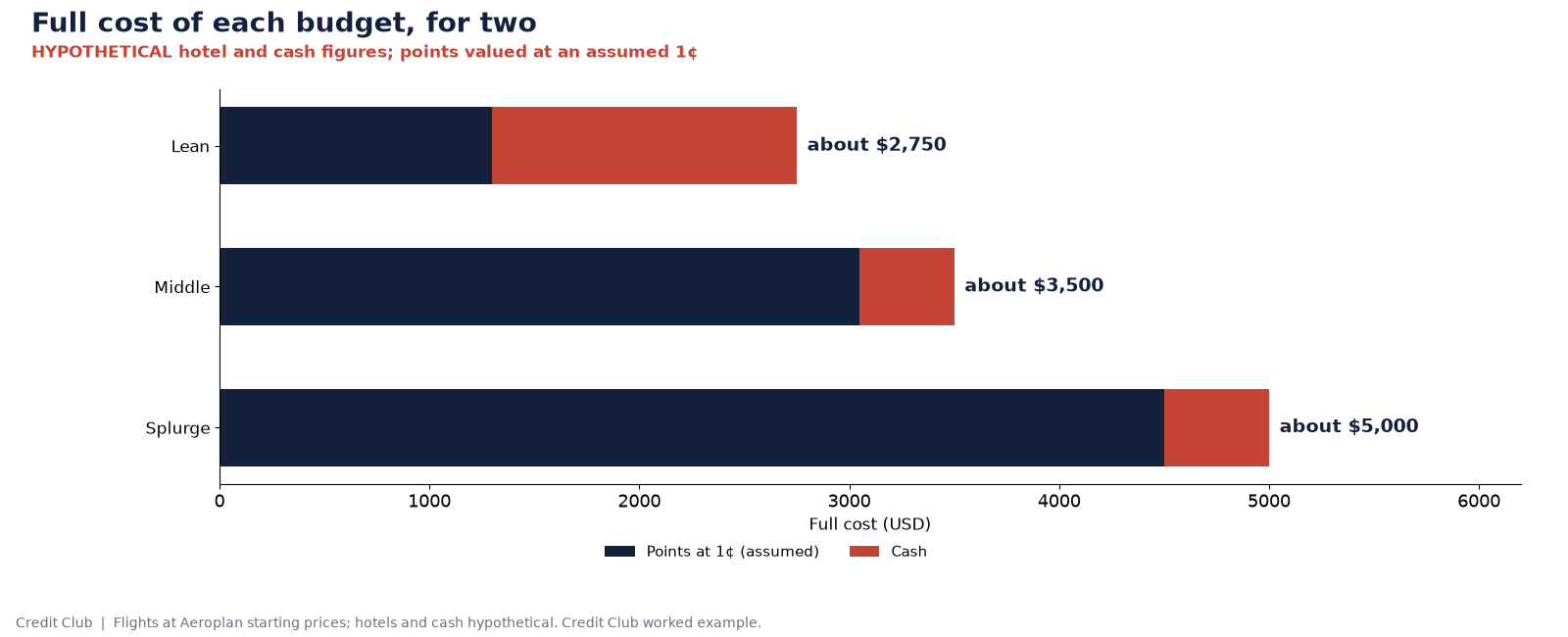
At an assumed 1¢ per point yardstick (our assumption, not a market value):
- Lean: 130,000 points (\$1,300) + about \$1,450 cash = about \$2,750.
- Middle: 305,000 points (\$3,050) + about \$450 = about \$3,500.
- Splurge: 450,000 points (\$4,500) + about \$500 = about \$5,000.
If business prices at the published median (133,800 points each way) rather than the starting price, the Splurge flights alone would be 535,200 points for two. That's why flexible dates matter most at the top budget. All hotel and cash figures are hypothetical; check live prices.
Where the cash goes
- Flight taxes and fees. US and European taxes and airport charges apply to award tickets. The return from Europe often costs more than the outbound. Our guide to award ticket fees explains the parts.
- Hotel taxes. Many European cities charge a nightly tourist tax at the hotel, even on award nights.
- Getting around. Trains, transfers and meals aren't covered by points in these budgets.
Choosing your budget
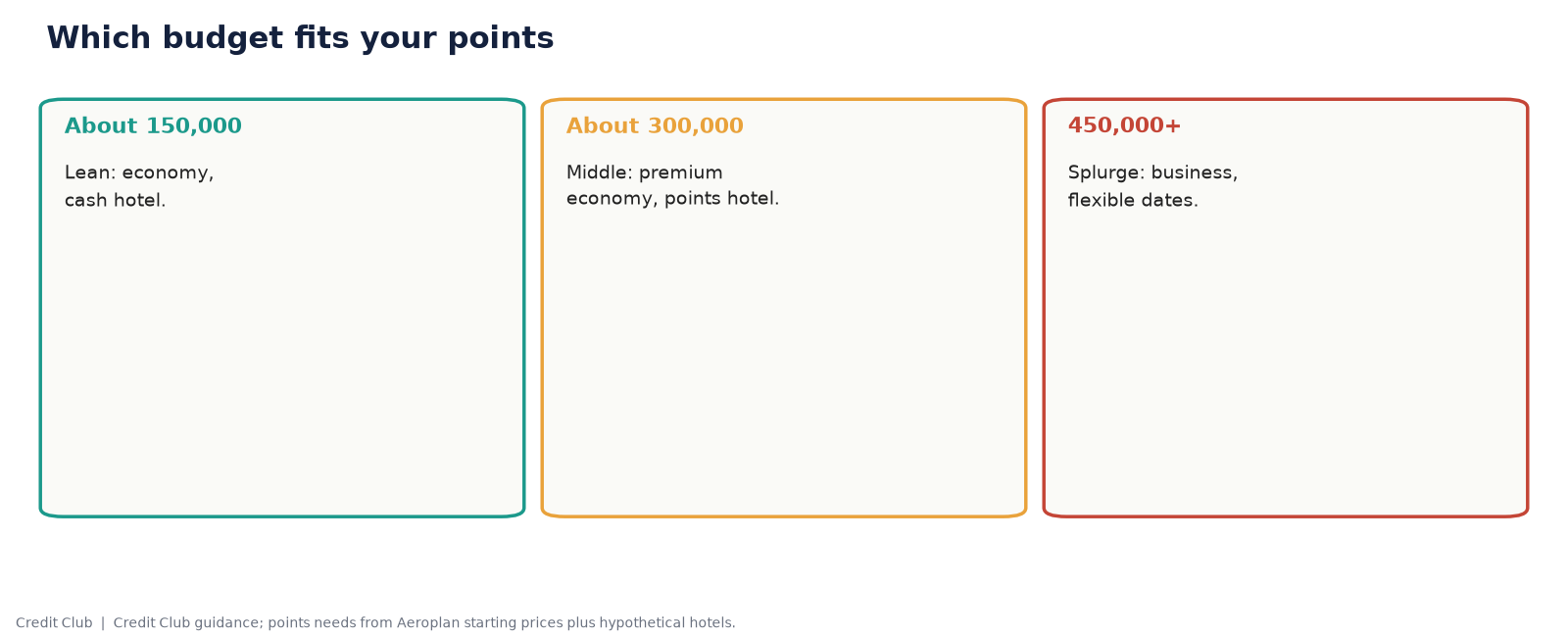
Lean suits people with around 150,000 points who'd rather save them for another trip; you fly economy and pay cash for a modest hotel.
Middle suits people with 300,000 points or so; premium economy makes the overnight flight easier, and points cover the hotel.
Splurge suits people with 450,000 points or more and flexible dates; business seats at the starting price are the hard part.
A first step for each budget
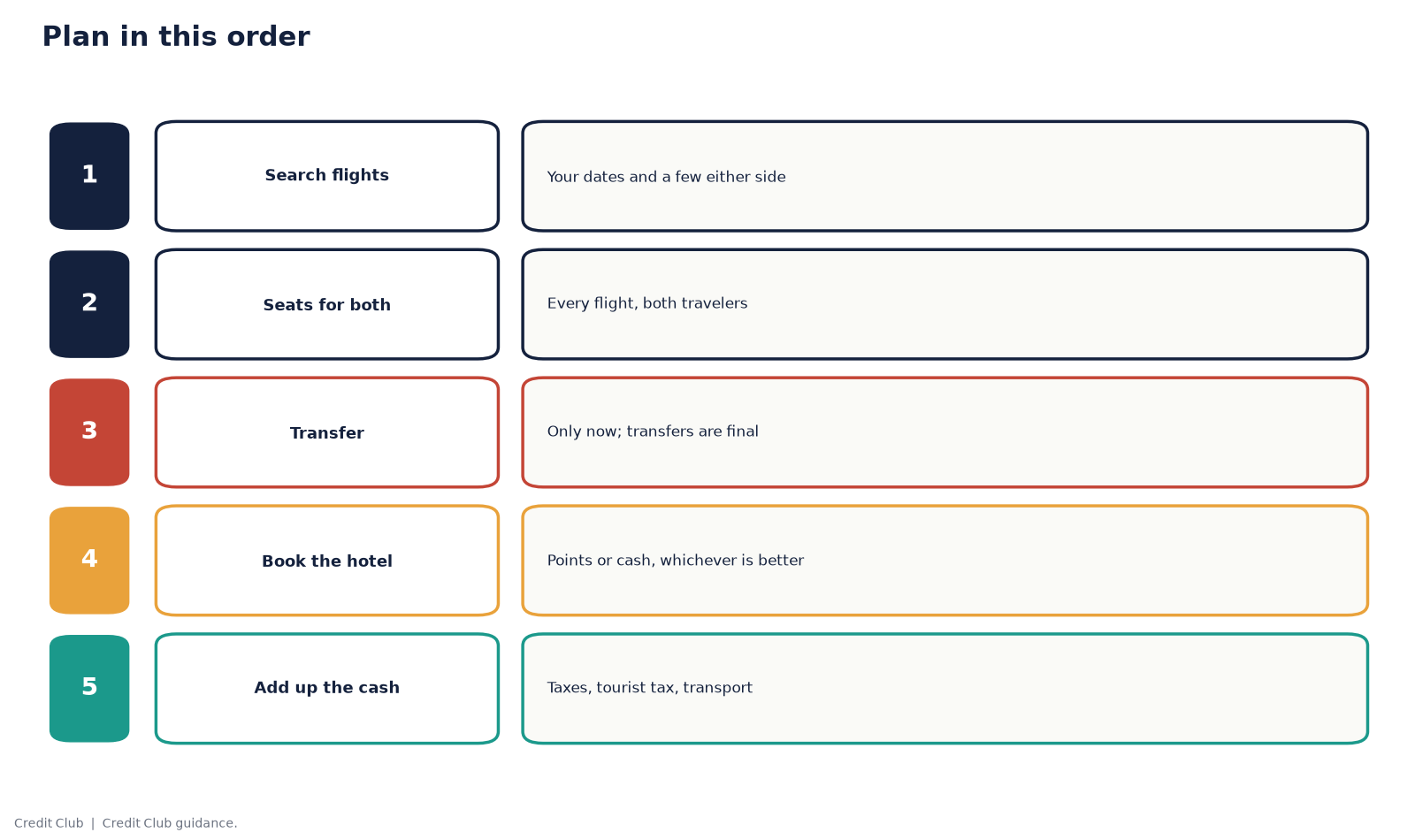
- Search the flights first. Look at Aeroplan for your dates and a few either side; note the cabin and price for both travelers.
- Hold off on transfers. Transfers are final; move points only when you see seats for both of you.
- Then book the hotel. Hotel award nights are usually easier to find. If you're using Hyatt, check the price level for your dates; see our Hyatt award chart guide.
- Add up the cash. Taxes, tourist tax and transport, before you commit.
Worked example: the Middle budget, step by step (hypothetical)
Suppose you hold 320,000 flexible points. You search Aeroplan for New York–Paris in premium economy across a two-week window and find Air Canada via Montreal at 50,000 points each way on a Tuesday, and back at the same price eight days later. You check that seats show for two travelers on both flights. Only then do you transfer 200,000 points to Aeroplan. Next you search a hotel program for seven nights in Paris and find a hotel at 15,000 points a night on your dates, 105,000 in total. Your taxes and fees come to about \$450 for flights and the city's nightly tourist tax. You have 15,000 points left. Every price in this example is hypothetical except the Aeroplan starting price, and we don't claim seats exist on any date.
When to skip points for part of the trip
- Cheap economy fares. If a round-trip economy fare is low, paying cash and saving points for business later may be the better use.
- Inexpensive hotels. In cities with modest hotel prices, a cash hotel can cost less than the points are worth at your yardstick.
- Short notice. Premium award seats close in can be scarce; a cash fare with points saved can be the realistic choice.
Mistakes to avoid
- Transferring for one traveler's seat. Check for both, every flight.
- Assuming the starting price. Plan for the median; celebrate the starting price.
- Forgetting tourist taxes. They're charged at many hotels even on points.
- Ignoring distance bands. A connection that adds miles can push the flight into a dearer band.
Trade-offs
- Points on flights vs hotels. Points often stretch further on premium flights, where cash fares are high, than on hotels in cheaper cities.
- Starting prices vs medians. Aim for the starting price, but plan for the median.
- Nonstop vs connecting. Connecting via Montreal can keep you in the lower distance band; some connections push you into the next band.
Fallback
If business won't price at the starting level, book premium economy one way and business the other, or economy out and business home, where the overnight matters less. If flights don't work at all, compare with a cash fare using our guide to points or cash. For the hotel, a cash rate with a card credit can beat points; our guide to hotel credits compares the main programs.
Europe on points: FAQs
Is 130,000 points enough for two in economy?
It matches Aeroplan's published starting price for two round trips on Air Canada in the 0–4,000-mile band. Many dates will price higher.
Can I mix cabins?
Yes, but each direction prices at its highest cabin under Aeroplan's policy; see our guide to mixed-cabin awards.
Which European cities fit the 0–4,000-mile band?
It depends on your departure airport and routing; the chart uses actual distance flown. Check the distance before you assume.
Do I need the same program for hotels and flights?
No. Flexible card points can go to an airline and a hotel program separately.
Should I book hotels with points or cash first?
Flights first; then compare a hotel's points price with its cash rate at your yardstick before choosing.
Can I start from another US city?
Yes. The chart prices by distance flown, so a longer flight from the West Coast may move into a higher band.
Are these prices guaranteed?
No. Flight prices are published starting points; hotels and cash are hypothetical.